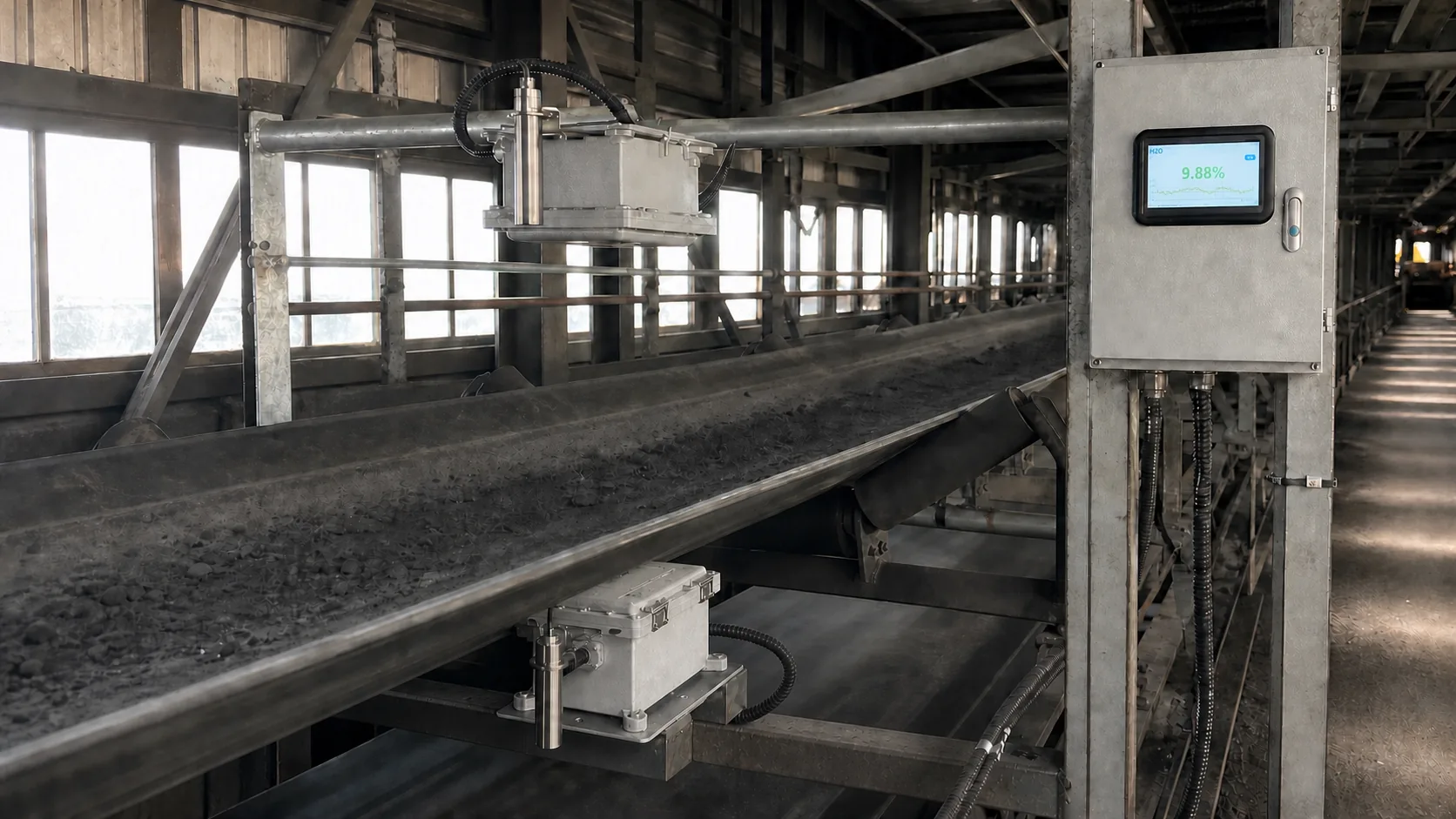
Documented application case · Coal and bulk minerals
Finding sustained coal-moisture changes without chasing every fluctuation
A grab sample and a live number answer different questions. This installation uses a through-material path to expose sustained changes while the operating team keeps belt state, loading and reference sampling attached to the result.
- System
- MW-3000 transmission microwave
- Material
- Coal on a conveyor
- Measurement point
- Fixed transmitter-receiver path
- Operating decision
- Investigate, sample, blend or hold
- Plant
- Bulk-coal blending terminal
- Line
- 180–240 t/h covered conveyor
- Previous check
- Four-hour grab sample with delayed rain-event visibility
- Review period
- 28 days · 126 paired references
The production problem
The risk is not only delayed information. A reading can also be misused when the belt is empty, the bed becomes shallow, density changes or product identity is wrong.
The field design therefore creates a trustworthy status around the moisture value rather than displaying an unexplained percentage.
Rain-event delay
Four-hour grab sampling meant wet-coal changes after rain were normally visible in the control room two to four hours later.
Invalid belt states
Empty or shallow loading produced events that looked like material change unless coverage and bed depth were evaluated first.
Blend variability
Operators could confirm an average result, but had limited evidence about when a deviation began and which production interval was affected.
How the measurement was placed
Keep geometry and operating state with the measurement
The installed path crosses the moving coal bed. Validity checks cover alignment, empty path, material depth, density grouping, temperature, belt condition and communications.
- 01
Through-bed response instead of surface-only observation
- 02
Material and belt-state context stored with the trend
- 03
Separate calibration and independent validation data
- 04
Alarm ownership and exception handling defined before use
2.4 GHz non-contact transmission path with the transmitter and receiver across the moving bed.
Ultrasonic height input compensates instantaneous bed-depth change.
Two 4-20 mA outputs and Modbus RTU are standard; further industrial protocols are optional.
Project execution
How the coal trend was made usable over 28 days
The commissioning team treated the moisture value, belt coverage and product state as one signal package. A total of 126 paired references covered dry operation, rain recovery and routine blend changes.
- 01
Define valid loading
Record the covered-conveyor geometry and set the minimum bed condition required before a moisture result can be used.
- 02
Capture representative references
Take time-aligned composite samples across the moving stream instead of relying on a convenient single grab point.
- 03
Test persistence rules
Compare 45-second trends with empty-belt and shallow-bed events so isolated jumps do not open an investigation.
- 04
Release a written response
Send a persistent valid shift to control-room review, targeted sampling and blend correction; keep commercial settlement outside the automatic route.
From signal to action
Respond to patterns, not isolated points
- 01
Detect a sustained shift
Review duration and magnitude instead of reacting to one spike.
- 02
Check the measurement state
Confirm coverage, bed depth, communications and product identity.
- 03
Pair the right reference
Align a representative sample to the same material and time window.
- 04
Use the approved response
Follow the written route for blending, review, acceptance or further testing.
Project result
Operators reacted to sustained coal changes instead of single noisy readings
Belt coverage, bed depth and product identity were evaluated with the moisture trend. Only a persistent, valid shift opened the investigation route.
Rain-event visibility
Time before a sustained wet-coal shift reached the control room
False moisture alarms
Empty or shallow-belt events removed before escalation
Blend time inside target band
Share of monitored blending time within the site moisture window
Earlier deviation visibility
Affected material can still be identified when a sustained change is reviewed.
Fewer false reactions
Validity checks help separate empty-belt or coverage events from material change.
Traceable follow-up
Trend, operating state and paired reference can be reviewed together.
The result applies to the stated material, installation and validation conditions. A new site establishes its own target band and response rule with paired reference data.
Validation status
Validation basis
- Online window
- 45-second trend with belt-running, coverage and product-state checks.
- Reference set
- 126 time-aligned composite samples collected across the moving stream.
- Decision rule
- Review, targeted sample and blend correction; no automatic commercial settlement.
Discuss a similar measurement point
Share the material, measuring position and decision you need to make. The first review is handled directly on WhatsApp.