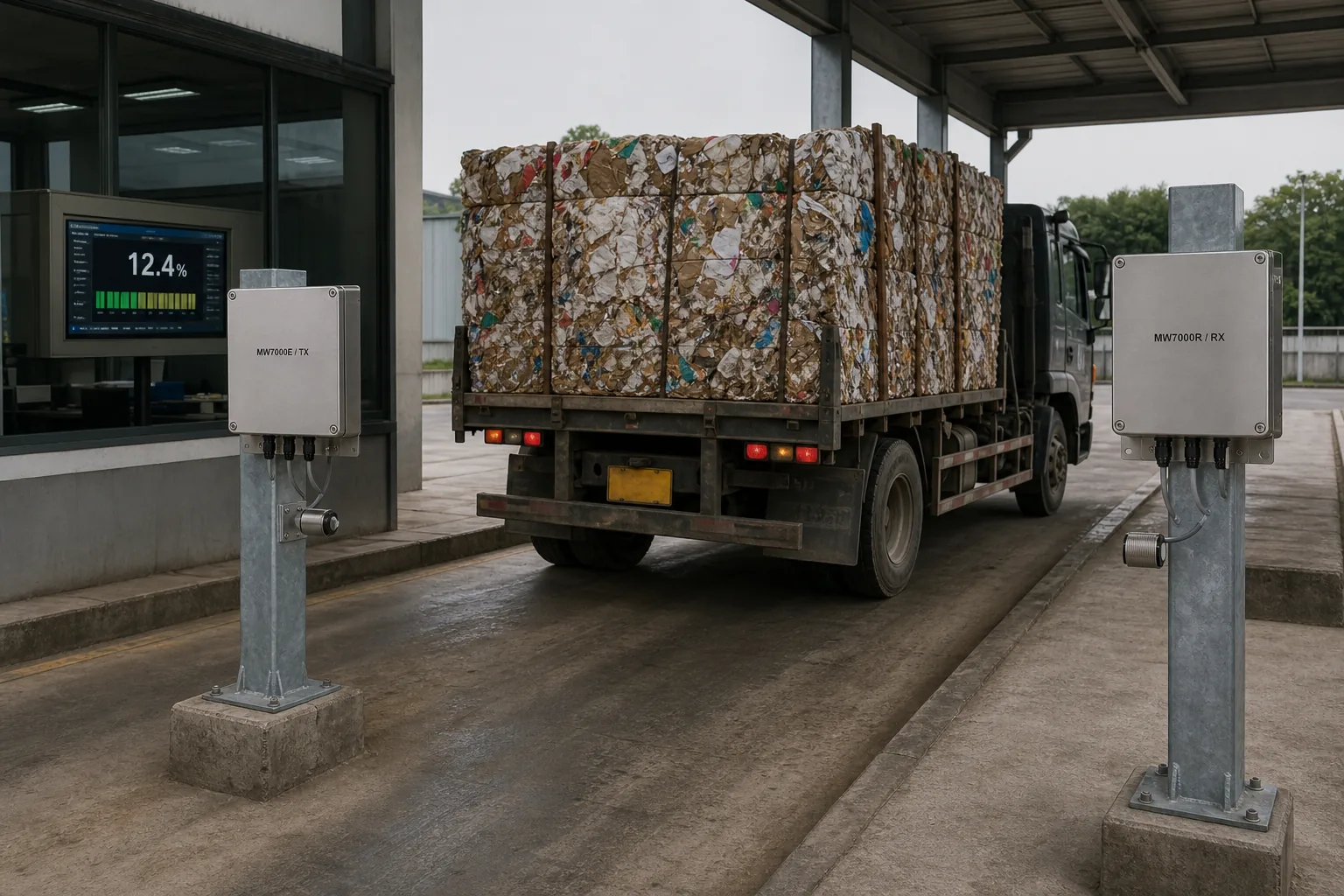
Documented application case · Full-truck incoming inspection
Turning a recovered-paper truck pass into a sectional moisture record
A full load cannot be represented by a convenient handful of samples. The MW-7000 installation scans the truck through a defined lane and organises the response by section, giving receiving, quality and purchasing teams one record to review.
- System
- MW-7000 full-truck microwave
- Material
- Recovered-paper truck loads
- Measurement point
- Vehicle inspection lane
- Operating decision
- Accept, investigate, resample or hold
- Plant
- Large recovered-paper processing site
- Line
- 35–50 inbound trucks per day
- Previous check
- Five accessible sampling positions per load
- Review period
- 60 calendar days · 2,120 valid truck passes
The production problem
Truck loads combine inaccessible zones, changing profiles and supplier variation. A useful system must know where the vehicle is, which sections were covered and whether the record is complete.
Vehicle handling, distance sensing, software and exception rules are therefore part of the measurement system.
Slow receiving decision
Five accessible sample positions still required an average of 18 minutes from lane entry to a recorded release decision.
Hidden load variation
The same routine points could miss a concentrated wet section or fail to show where the change occurred along the vehicle.
No sectional history
Receiving retained a final decision but had no complete section profile to review with supplier identity and later disputes.
How the measurement was placed
Measure the truck as a sequence of sections
Transmitters and receivers are installed across the lane with distance or profile inputs and dedicated PC software. The system follows the vehicle pass, displays section changes and retains the original record.
- 01
Defined vehicle position, direction and scan coverage
- 02
Section profile instead of one load average alone
- 03
Distance and load profile reviewed with the result
- 04
Record available for receiving, quality and approved ERP hand-off
925-980 MHz transmitter-receiver path with two ultrasonic distance inputs for vehicle-width compensation.
Software retains the full-load average and section values, with section count determined by vehicle speed.
The system provides two 4-20 mA outputs, RS485 Modbus RTU, history and print functions.
Project execution
How 2,120 truck passes became a controlled receiving route
During the 60-day review, vehicle position, direction, speed, load profile and section completeness were checked before a pass was accepted. Exception loads and a planned audit subset remained tied to the reference method.
- 01
Control the lane entry
Define approach direction, speed window, vehicle position and the conditions that require a repeat pass.
- 02
Segment the load
Use distance and profile inputs to divide the moving load into reviewable sections instead of publishing only one truck average.
- 03
Verify abnormal sections
Send concentrated wet zones, incomplete coverage and the scheduled audit subset to targeted reference sampling.
- 04
Connect the disposition
Store vehicle ID, supplier, section profile and accept-resample-hold decision together before an approved ERP hand-off.
From signal to action
A receiving decision with an evidence trail
- 01
Register the load
Attach supplier, vehicle, material and arrival identity.
- 02
Capture sections
Scan while monitoring vehicle position and coverage.
- 03
Review exceptions
Flag concentrated wet areas, missing coverage or abnormal conditions.
- 04
Release the record
Accept, request reference sampling or hold under the written rule.
Project result
Section data shortened receiving while preserving an evidence trail
The vehicle pass, load profile, valid sections and final disposition were stored as one load record. Concentrated wet zones triggered targeted resampling instead of repeating the same routine pattern on every truck.
Inspection-to-release time
Average from lane entry to receiving disposition
Routine full manual sampling
Manual sampling reserved for abnormal sections or incomplete coverage
Loads with reviewable section records
Vehicle ID, section profile and disposition retained together
Wider load visibility
Receiving sees how moisture changes along the vehicle instead of relying on one average.
Consistent exception handling
Coverage gaps and abnormal sections follow the same review path.
Auditable receiving record
Vehicle identity, sectional result and final disposition remain linked.
The result applies to the stated material, installation and validation conditions. A new site establishes its own target band and response rule with paired reference data.
Validation status
Validation basis
- Scan condition
- Direction, speed, vehicle position, load profile and section completeness recorded.
- Reference set
- Exception loads and a scheduled audit subset sampled against the receiving method.
- Decision rule
- Accept, targeted resample or hold; commercial adjustment followed the site agreement.
Discuss a similar measurement point
Share the material, measuring position and decision you need to make. The first review is handled directly on WhatsApp.