← Back to all industries

Industries and materials

Chemicals and industrial powders

Fertilisers, salts, detergent powders, resins and mineral powders vary in density, particle size and composition. Calibration must stay within a defined product envelope, while hazardous-area suitability, material compatibility, product-contact requirements and environmental protection are verified separately for the actual project.

Contact an engineer
Chemicals and industrial powders

Process scenes and measurement points

Follow the material from moisture risk to control action

Each route starts with a real material flow. Define the risk, choose a representative measurement point and decide what the validated result will change.

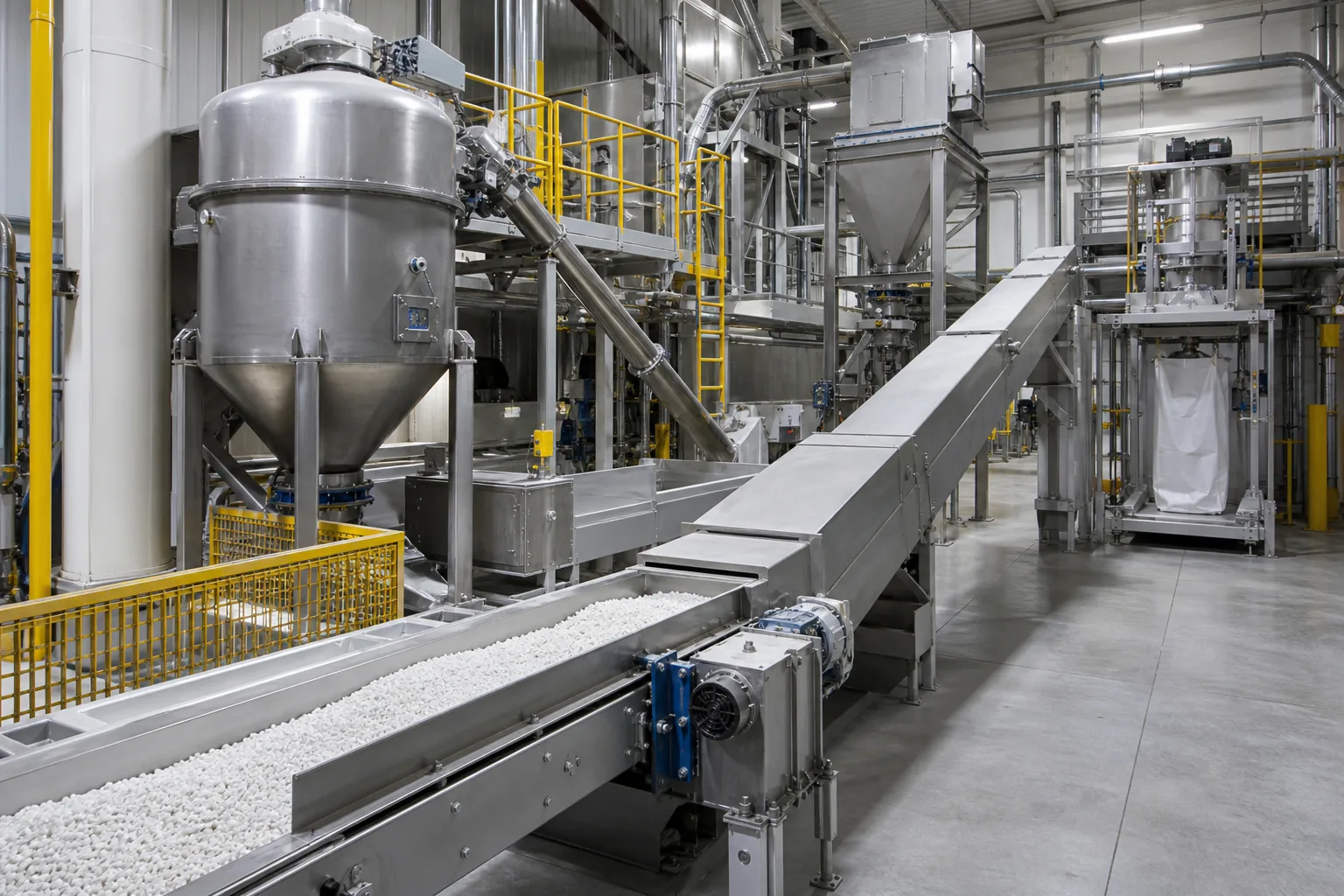
Powder and granule receiving
01Powder receiving and storage

Powder and granule receiving

Material
Fertiliser, salts, detergent powder, resin and mineral powder
Moisture risk
Grade, density and moisture variation can drive caking, storage loss and inconsistent processing.
Measurement point
A stable conveyor or chute after receiving, with site safety and material compatibility verified separately.
Control action
Accept, segregate, dry or assign the material to the correct storage route.
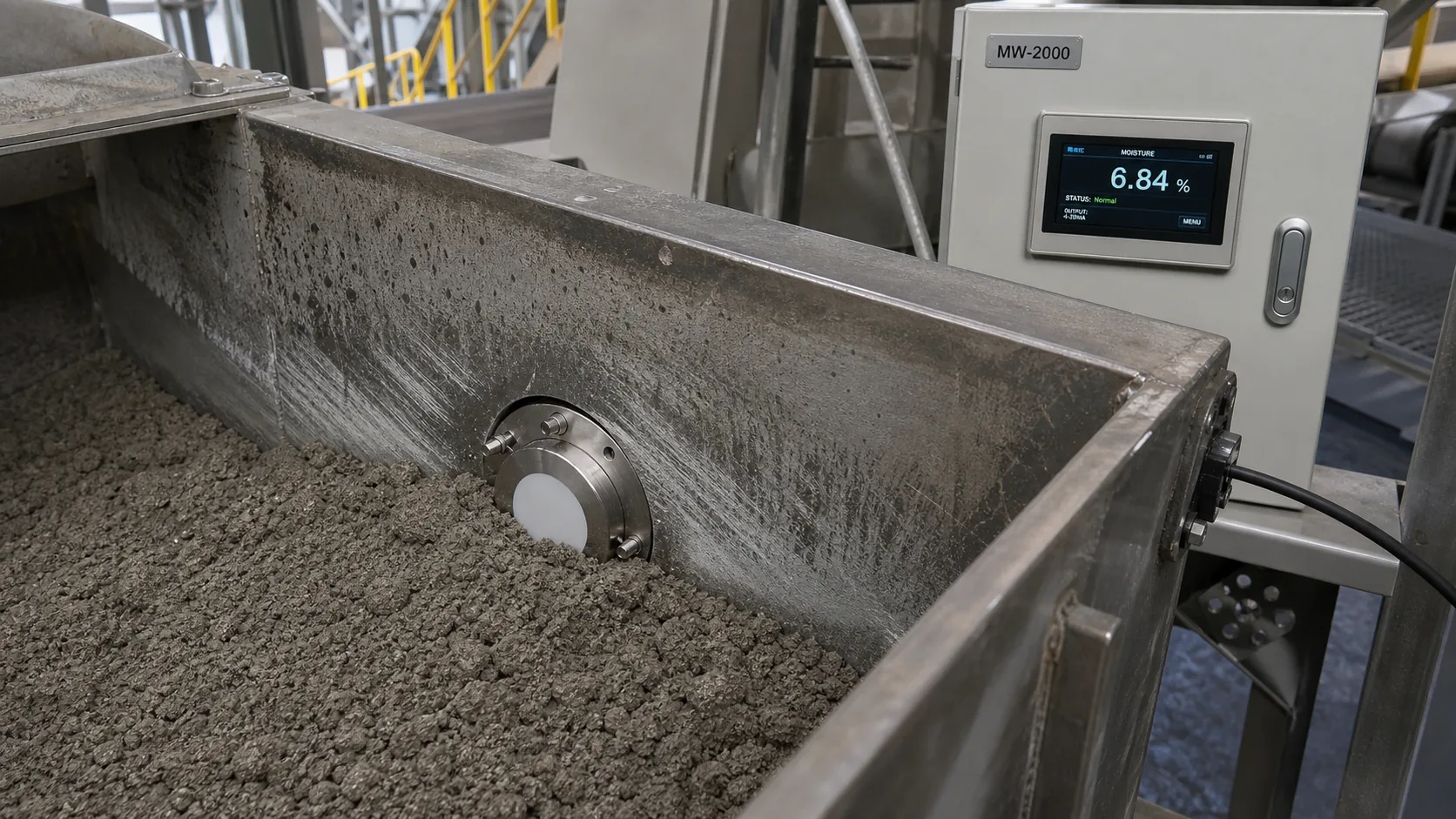
Mixer, granulator or dryer
02Mixing, granulation and drying

Mixer, granulator or dryer

Material
Blended powder, wet granules and drying product
Moisture risk
Moisture variation changes granulation, drying load and final physical properties.
Measurement point
A point representing the material affected by the next action, with mixing and transport delay mapped.
Control action
Trial bounded addition or dryer changes and verify final properties before automation.
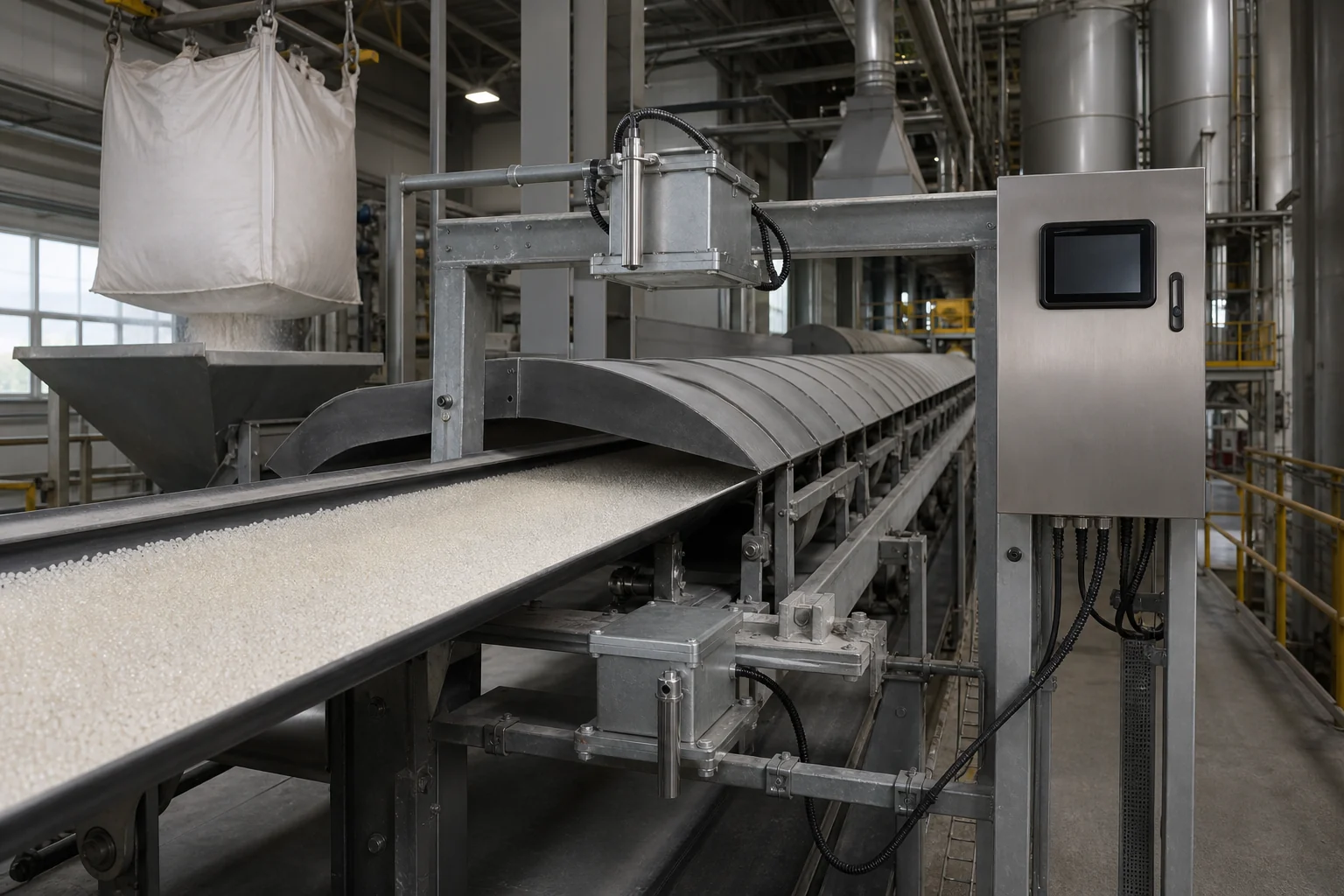
Packing and dispatch
03Packing and dispatch

Packing and dispatch

Material
Finished industrial powder and granules
Moisture risk
Residual moisture can cause caking and handling problems, while invalid values weaken batch traceability.
Measurement point
A stable pre-packing or loadout stream tied to batch, grade and equipment state.
Control action
Trigger quality hold or release and retain auditable alarms without losing data-quality context.

Practical moisture testing

How to measure moisture in chemicals and industrial powders

Fertilisers, salts, detergent powders, resins and mineral powders vary in density, particle size and composition. Calibration must stay within a defined product envelope, while hazardous-area suitability, material compatibility, product-contact requirements and environmental protection are verified separately for the actual project.

01

How do you measure moisture in powders or granules on a conveyor or chute?

Use a stable, representative flow with defined sensor distance and coverage. Select a route that fits whether the material is on an open belt, in contact with a wear surface or measured through a controlled path, then verify site safety and material compatibility as separate project requirements.

How to do it
  1. Document flow geometry, product grades, particle-size range and normal layer depth.
  2. Choose a location with repeatable presentation and safe reference sampling.
  3. Validate empty, low-load and full-load states before calibrating production values.
Variables to control

Density, layer depth, particle size, dust, build-up, temperature, abrasion, metal structures, hazardous-area classification and contact-material compatibility.

Use the result to

obtain a valid continuous signal instead of converting geometry changes into false moisture values.

Read the full methodChemical and industrial powder moisture measurement in dryers, chutes and blenders
02

How do you control powder moisture in a mixer, granulator or dryer?

Measure at the point where the value represents the material affected by the next action. Account for mixing and transport delay; automate only after recipe limits, the site control interface and fail-safe states have been verified.

How to do it
  1. Map addition, mixing, granulation, drying and discharge timing.
  2. Establish target and action bands for each product family or grade.
  3. Trial bounded changes under operator control and verify final properties with reference tests before enabling automation.
Variables to control

Recipe, batch size, mixing uniformity, residence time, temperature, fines, process lag and interlocks.

Use the result to

reduce batch variation while protecting granulation, drying and downstream quality.

Read the full methodMixer moisture control: connect the sensor window to water addition and batch release
03

How do density, particle size and temperature affect powder moisture readings?

These variables can change the sensor response even when water content is unchanged. Reduce them mechanically where possible, then include the remaining operating range in the dataset and validity rules.

How to do it
  1. Record density, particle size, temperature, grade and presentation with reference samples.
  2. Test residuals to identify variables that require compensation or separate models.
  3. Define validated limits and flag readings taken outside them.
Variables to control

Compaction, aeration, fines, grade changes, sensor distance, temperature and partial coverage.

Use the result to

separate genuine moisture variation from product or presentation effects.

Read the full methodWhy density, bed depth, distance and temperature change moisture readings
04

How do you calibrate a moisture sensor for different chemical grades or colours?

Treat grade and colour as controlled dataset variables. Combine grades only when validation proves that one model meets the required error for each group.

How to do it
  1. Design the sample matrix across grade, colour, moisture and temperature ranges.
  2. Use one consistent reference method and reserve independent validation records.
  3. Review bias by grade and release only the model versions that meet the acceptance criteria.
Variables to control

Unbalanced samples, formulation change, optical colour effects, volatiles, reference method and model version.

Use the result to

know when a shared calibration is valid and when a grade-specific model is necessary.

Read the full methodDesign a calibration dataset that covers real production
05

How do you send powder moisture alarms and values to a PLC or MES?

Send value, unit, basis and status as separate controlled fields. The PLC should block control on empty flow, maintenance, out-of-range or communication fault rather than treating every number as valid.

How to do it
  1. Create a signal dictionary for value, scaling, states, timestamps and filtering.
  2. Map readings to batch, recipe and equipment state in the PLC or MES.
  3. Commission end-to-end scaling, alarms, invalid states and loss-of-communication behaviour.
Variables to control

4–20 mA or register scaling, filter delay, clock synchronisation, access rights and configuration revision.

Use the result to

turn the measurement into auditable alarms and production records without losing data quality context.

Read the full methodFrom moisture sensor to PLC and MES: design the complete data chain

Project success factors

Build a reliable measurement result

Share your material, moisture range and process conditions to receive a focused measurement recommendation.

  • A clearly defined material and process objective
  • A suitable sensor route and installation geometry
  • A representative reference method and calibration plan
  • Environmental and compliance requirements
  • Validation under real operating conditions

Application pathway

Place the measurement where it can change the process

Fertilisers, salts, detergent powders, resins and mineral powders vary in density, particle size and composition. Calibration must stay within a defined product envelope, while hazardous-area suitability, material compatibility, product-contact requirements and environmental protection are verified separately for the actual project.

01

Locate the variation

Map where moisture enters, separates, dries or is mixed before choosing an accessible measurement point.

02

Choose the representative point

Match surface, contact, transmission or scanning coverage to the material flow and the decision that follows.

03

Connect the reference

Align representative samples, method, calculation basis and laboratory time with the online measurement window.

04

Define the production action

Assign valid states, alarm limits, manual response, control authority and a review method for abnormal material.

Sources of moisture variation

Sources of moisture variation

Composition, grade, solvent or volatile content, aeration, particle size, colour and build-up influence industrial-powder measurement.

Reference and operating response

Reference and operating response

First close hazardous-area, corrosion, dust and cleaning requirements. Then choose a representative surface, contact interface or controlled transmission bed and validate each product family before linking the value to drying, blending, alarm or release logic.

Begin with an observation period that records the online value, reference samples, product identity and operating state. Use the combined record to set material groups and valid limits. Then introduce alarms, operator guidance or bounded control in stages, with a manual fallback and a documented response for off-specification or unmeasured material.

Discuss your material, process point and control objective

Share a few process details and our application team will recommend a suitable technology, installation concept and validation plan.

Contact an engineer
WhatsApp